Thursday, May 28, 2009

Spanish Learning Chapter - 18

An Amazing Source of Developing Fluency


I've enjoyed my return to Spanish class here in Guanajuato immensely. It's been a little strange because basically one ends up taking classes mainly with other Americans with a few other nationalities thrown in for good measure. I haven't been around my fellow Americans in so long that it's taken a bit of getting used to. In the last five years, I have actually forgotten social cues and topics of conversation within polite company. But, it's been fun, informative, and actually a confidence booster.

It's been an encouragement to notice just how advanced I've become in my Spanish. While living in Mexico full-time and in Mexican neighborhoods has had a linguistic impact on my Spanish, I have to stress the point that you still have to put in the hard work in the language to become fluent. I've had to answer this question more than once, "If you live in the city of Guanajuato why on earth are you in a classroom in a Spanish school?" I suppose my assumption has been a correct one when hypothesizing in my previous articles that most, if not all, of those coming from monolingual America make an assumption about second language acquisition that simply is not true.

The first thing I've written about is that most would find it astounding that I would perceive the need to take classes when I live in Mexico. In my explanation to the class, especially in the conversation classes where we have the freedom to take off on tangents, I see the utter confusion in the faces of my classmates that you still have to do the work in second language acquisition even when living in the country in which the language is spoken by the natives. "There is no magic", I explain, "in living in Mexico if you want to learn Spanish." While there are certainly far more opportunities here than living in a Hispanic-free American city (something that is becoming increasingly impossible to find), there is no osmoses where you just magically become fluent. You still have to work at it.

The second thing I've written about is how American adults have this idea that children learn languages faster than adults. This is not true and science attests to this fact. While children have a better chance at "sounding native" than adults, they do not necessarily learn a second language more rapidly. I've written a great deal about this fact and even have a large section about this in one of my books. Children do not have the emotional problems (the embarrassment factor) that adults do in learning to speak another language. Adults are afraid of looking stupid. Children, when trying to learn a second language, engage in a silent period in which mostly they listen in the second language. Very little, if any, production of the language is attempted at first. Eventually production comes but first comes about 18 months of intensive listening. What this does is teach the sounds, the music, or the euphony of the language. They learn by shutting their mouths, not trying to speak at first, and following commands. This is part of the natural order of second language acquisition. It is what is almost totally lacking in adult second language acquisition.

The third thing I've been harping on in my missives is related to the second: the natural order of second language learning is horribly frustrated in almost ever single Spanish school in the world. In almost every single course you fork out good money to take, you are put into a position of reproducing (speaking) the language before you know what that language sounds like. Because adults try skipping this step they learn the language incorrectly. They will spend the rest of their lives mispronouncing the language. Because they tried reading and speaking what they were reading, they interpreted the sounds according to an English phonetic system. An English "e" is not pronounced the same way in Spanish! But, unless you spend time hearing Spanish spoken first, you will lock yourself into some very bad pronunciation habits and will become essentially not understandable.

And frankly, if you cannot be understood, all the Spanish classes in the world and your memorization of all the Spanish grammars and dictionaries in existence will do you no good in spoken communication.

A fourth thing near and dear to my heart in my past writing about Second Language Acquisition is: Age and Level Appropriate Input. You would not (and did not) put your child in a lecture on the Writings of Shakespeare in order to learn his or her native language. You just simply did not do that. You sought out, in addition to your child's natural exposure to the language, books, tapes, videos, CD's and television with material that was at an Age and Level Appropriate level. Then, as the child progressed, either you or he or both of you sought out more challenging material. This is exactly how all of us learned our first, second, third, fourth, and so on, languages. In the case of adults trying to acquire a second language, they MUST engage in the same natural order as the first language was mastered. Level appropriate material must be inputted and when mastered, you graduate to something level appropriate but a little more difficult in order to have the challenge.

This is really a faltering point, in my view, in minds of most adults trying to acquire a second language. What they want is spoken fluency. And yet, what they seek in the run-of-the-mill language instruction is learning how to be a good Spanish (or any language) linguist. They come to Spanish school with lots of local Junior College Spanish semesters under their belts and complete a written test, scoring in the advanced stage of Spanish. They can fill in the blanks on a proficiency exam and name the correct parts of speech and score very, very high. Some get into advanced classes and have the greatest difficulty in stringing the most basic Spanish words together to form a cogent sentence. And their pronunciation is so terrible they are all but incomprehensible. The simple explanation is that they engaged the second language acquisition task by putting the cart before the horse. Before ever trying to produce a proper sound in the language, they were in a level-inappropriate situation trying to read, write, and speak things from the language, which would be equivalent to requiring your American child to read, write, and speak Shakespearean English.

What my wife and I did before coming to Mexico was purchase the Spanish program called LEARNABLES. This is a 100% non-speaking Spanish course. All you do is listen to level appropriate Spanish being spoken while looking at cartoon drawings. By the end of the 5th level, you will have heard thousands upon thousands of repetitions of the language. You will have engaged in the natural order of first and second language acquisition of just listening and learning the sound of the language. Then, and only then, did we proceed to Spanish-speaking courses that built upon that level.

Still, we are reading and listening to level appropriate material. Even after living in Mexico for six years, we are not ready to read Don Quijote in the original Castilian. We will one day. But, not yet.

Here is the most important point you must take away from this essay: Stop trying to read, write, and speak Spanish at an adult level if you are at the spoken fluency level of a five-year-old Spanish-speaking child. Expose yourself to what a child would understand with the view of progressing to greater things. Do what a Spanish-speaking child at that level of fluency would do.

Just today, I was talking to an elderly English speaker who is trying to learn Spanish. His Spanish is all but incomprehensible. What he is seeking is a level of Spanish instruction far too advanced for his actual level. He is like a child seeking to understand Shakespeare. He can't do it.

I suggested watching cartoons and his reaction to that was predictable. I've run into this over and over with adult Americans but not with adults from any other country. The adult Americans absolutely refuse to believe that this will assist them in reaching their goal to develop a high degree of spoken Spanish fluency. Some of them are insulted, as was this person today. And yet, they are spending a fortune to come to Mexico, enroll in Spanish classes, and leave this country in the same identical linguistic condition that they came in.


Looking for level appropriate Spanish input to train that monolingual ear of yours? Listen to the following in Spanish: Sponge Bob, The Simpsons, or anything you would deem mindless in English that appears on Cartoon Network.

Graduate from there to I Love Lucy and other black-and-white sitcoms you've seen thousands of times in English. Don't knock it when you still are trying to figure out how to communicate the basics in Spanish.

###

LEARN SPANISH VERBS NOW Click Here!

Wednesday, May 27, 2009

Tomatillos

When we moved to central Mexico six years ago, we encountered quite a few fruits and vegetables, tomatillos for one, with which we were unfamiliar.

Tomatillos (toe-mah-tee-yohs) belong to the Nightshade family, as do tomatoes. Tomatillos are covered with a husk and are harvested while green. Though tomatillos are sometimes called "tomate verde" (green tomato), they are not the unripe form of the tomatoes you might use on your salad or to make spaghetti sauce (those are usually referred to as jitomates in Spanish). Tomatillos can range from the size of a cherry tomato up to a small tomato and are sometimes called husk tomato, ground cherry, Mexican tomato or jamberry.

As tomatillos ripen, they change in color from green to yellow, red or even purple. Tomatillos should be used while green or they will not only lose much of the tartness that adds zest to recipes but also much of their nutrition.

Choose tomatillos that are bright green and firm with greenish-brown husks. The tomatillo should completely fill the husk. Under the husk, the skin of the tomatillo may feel a bit sticky. This is normal. Tomatillos with the husks attached can be stored in the refrigerator for up to two weeks. If you remove the husk and wash the tomatillos, they can be kept in the refrigerator in sealed plastic bags for up to a month. They can also be frozen, either whole or sliced. However, slicing them exposes more surface to the air and they will lose some of their nutritional value.

Tomatillos are a staple in Mexican cooking. They are eaten raw, cooked, roasted, and also are used to make various sauces (salsas).

1 medium tomatillo has only 11 calories, but gives you 7% of the RDA of Vitamin C. Tomatillos are low in saturated fat, cholesterol and sodium. They are a good source of fiber, iron, magnesium, copper, phosphorous, niacin, potassium, manganese, and Vitamin K. The only "bad" thing about them is that about 7 of the 11 calories come from sugars (about 1 gram).

Here is an easy recipe for salsa made with tomatillos that I learned from a Mexican friend. This can be used as a dip or poured over eggs, omelets, enchiladas, or meat. My friend uses chile de arbol, a very hot chile, when making this salsa for her family, but uses milder chiles when cooking for others. I like to use serrano chiles, which are a bit milder but still have a kick. This salsa tastes great warm or cold.

Tomatillo Salsa

1 pound tomatillos (10 to 12), husks removed and washed
½ of a large onion, coarsely chopped
2 serrano chiles, seeded and chopped
2 cloves garlic
2 tablespoons limón juice
2 tablespoons cilantro, coarsely chopped
½ teaspoon salt

Place the whole tomatillos in a saucepan and fill with water until the tomatillos are just covered. Bring to a boil, then reduce heat to medium and cook for 8 to 10 minutes until soft. Drain.

Put the cooked tomatillos and the rest of the ingredients into a blender or food processor. Blend or pulse until smooth. You may have to do this in batches if your blender or processor is not large enough. Add more limón juice or water if you want a thinner salsa. If the salsa is too tart, you can add sugar to taste.

###

A Walk Through Mexico's Crown Jewel: A Guanajuato Travelogue

Tuesday, May 26, 2009

Guanajuato, Mexico: Dark Side - 1

Someone in a forum once said that without having skills in Spanish you can never begin to understand the Darker Side of Mexican Culture. And, very dark can that side be, sometimes.

I recalled this while I sat in my living room today listening to Carlos and his wife pour out their hearts to us concerning the tragedy of losing their foster children (really their sobrinas--nieces)to Carlos' shiftlessly worthless brother.

Carlos and his wife took in Carlos' brother's two daughters (two of ten sired between three women) six years ago when the girls were all but babies. Carlos and his wife have cared for and raised these girls as their own daughters. Already with three children of their own, they did not hesitate in taking in the children when circumstances dictated it.

Carlos' brother, and his brother's floozies, are inescapably criminals. Carlos would not divulge what kind of criminality into which these worshipers of darkness practice but it doesn't matter. His children by these "ladies" are often seen in the streets of Guanajuato begging for money. This is the only motive that can be divined as to why, after more than six years, he shows up at Carlos' house and takes these two precious girls, ripping them from the only loving care they've known, to end up in God only knows what sort of vile and nefarious enslavement. A life of slavery.

None of this monster's children are being schooled and the two ripped from their loving womb were taken out of school.

Multiple women with hordes of kids is not an isolated sort of incident here in Provincial Mexico. In fact, where Carlos is from, Mexico City, this heinous Provincial practice of having more than one family, not supporting any of them well, seems to be dying out in favor of more "civilized" behavior. This was the exact word Carlos used: "A more civilized region of Mexico..."

"Provincial and uncivilized" are the words Carlos used in describing the reason for this bigamy at the cost of children's lives is so widely practiced in the Central Mexican Highlands.

This is not the first time I've written or heard about this. The last time I wrote of it I received threats from Gringos, not the Mexicans, but from terminally monolinguistic Gringos who could not string enough Spanish together to order dinner much less have two grief-stricken Mexicans tell you their plight in your home.

When Carlos and his beloved left I wasn't mad that I learned of this dark side of Provincial Mexican Culture. I learned of this sort years ago. I was mad at the thought of Gringos believing they are so in touch with this culture that they would recoil at the thought of my reporting this sort of thing.

Have you ever wondered why so much of the screed written on Life in Mexico is so Ivory Tower that you can't read it for the blinding brilliance? And why are Americans here so gullible they fail to see the culture’s defects. Everything, no matter how objectionable, is "a beautiful native custom" and all Mexicans "are a beautiful people"...


I have.

Monday, May 25, 2009

Go To The Movies: A Lesson in Culture

I know, I know, I've written about this before but it is so odd, so mysterious, so irksome that it warrants another look at this.

Last weekend the wife and I went to see the new movie, Angels and Demons, based on Dan Brown's book of the same title. In fact, we read this book when it first came out some years ago.

The showing we attended happened to be in English with Spanish subtitles. I can't remember when we last saw a movie in English but the time we wanted to attend, so as to avoid the headache of find a taxi home at a later hour, had this format.

If you want a lesson in culture, a.k.a. how Guanajuatenses watch movies, then you've got to attend a movie when here. Any movie will do, and you won't be disappointed.

I used to believe that the bizarre movie going behavior I first noticed was due to the fact that the Guanajuatenses attending the movie couldn't follow the subtitles in the rapidity in which they flash on and off the screen. I mean, I can barely do so in the few movies I've tried watching with English subtitles.

They act the same no matter what language the movie or subtitles is in.

After a careful and most certainly scientific observation of Mexican youth in Guanajuato at the movies I've concluded that they don't come to the movie to watch the movie. In the age category of 0 - 30, Guanajuatenses youth come to the movies and pay the $45.00 peso (Yikes!) ticket price to do anything but watch the damn movie!

The movie we were at was intense.

Angels & Demons is a bestselling mystery-thriller novel written by American author Dan Brown. It is directed by Ron Howard, with Tom Hanks, Ewan McGregor, Ayelet Zurer. The protagonist, Harvard symbologist Robert Langdon, works to solve a murder and prevent a terrorist act.

I liked this movie very, very much. It is high-octane action and I cannot begin to imagine watching it and having to depend on the micro-nano-second appearances and vanishings of subtitles.

As we sat there sipping our watery diet coke and waiting for the movie to begin, the rest of the audience showed up.

The only persons near our age sat directly in back of us. They seemed like lovely middle-class Mexicans who I believed, and was proved correct, were there to see the movie. The rest of the movie were children who appeared to be four or five years old on up into early thirties.

The place was packed. People came in trying to find seats and not fall over from the balancing of their trays of popcorn and coke.

When the previews of future movie madness coming to a theater near you came on, the volume of talking rose to a fever pitch. No one, you see, watches the previews. They act as though this is their theatrical cue to begin screeching their heads off to one another talking about God only knows what. This continues until the featured movie begins.

Strangely, there is a hush that falls over the packed crowd for about three minutes while the opening of the feature plays. Then it is as though they aren't even aware of where they are and what it is they are suppose to be doing--movie watching.

Let me just say here that the whole act of deciding to go to the movies, routing around in dirty pants and under couch cushions trying to come up with the $45.00 pesos ticket fee, getting to the theater, buying nasty movie-made refreshments, seems to me to be in vain when once you get here and the movie begins you don't watch it. Why bother?

And, not watching the movie is what the do.

In two rows directly in front of us, out came the cell phones. That eerie bluish, ghostly glow from the microscopic screen just unnerves me. Why can't they have green screens like a radar console has. Someone must have gotten a really pithy text message, so I am guessing, and had to pass her cell phone up and down the row. It looked like a little blue fairy dancing about in a floating manner visiting each college-age youth so as she was blessing them.

Two or three college students whipped out some headphones, plugged them into a MP3 video device, and began watching music videos THROUGHOUT THE ENTIRE MOVIE!

There were two of that ilk sitting next to me. Not only did this twenty something guy talk during the entire movie, he laughed. He actually would belly-roar laugh when a murderous scene would come on the screen. And I mean this movie was graphic in showing a Catholic Cardinal being roasted alive in a Messianic pose at the altar of a church in Rome. It was definitely NOT a comedy.

The guy laughed!

I would love to tell you that this was a one-time event. I have seen it all too often.

The children in the crowd were to busy having their parents try to hush them up or going to the bathroom to get rid of the cokes they guzzled before the movie. (I don't know why this does not occur to parents, but letting a small child have a 32 ounce coke before a movie is going to guarantee that neither you or the kid is going to be watching the movie. Why not take them for pizza and all the coke they want AFTER the show?)

Such is the movie-going life in Guanajuato. I can't say whether this behavior is so in other parts of Mexico since it is only in Guanajuato I've gone to the movies.

Maybe I should start subscribing to Netflix as they do in San Miguel de Allende...

###

Click On This Link Reach The ROCKET ROCKET SPANISH Website!

Saturday, May 23, 2009

Guanajuato, Mexico Food: Chilaquiles

By

Cindi Bower

Chilaquiles (pronounced chee-lah-KEE-lehs) is a popular breakfast or brunch dish throughout Mexico. It may have been developed by cooks as a way to use up stale tortillas and leftover salsa from the previous day's meals.
The name, chilaquiles, comes from the Nahuatl word chil-a-quilitl, which means "herbs or greens in chili broth."

Chilaquiles are made from stale tortillas cut in strips or, more popularly, in triangles (called totopos) that are fried until crispy and then covered with red or green sauce.

There are a number of different ways to prepare chilaquiles. Instead of using red or green salsa, some cooks cover the fried tortillas with mole (a spicy-sweet sauce made with many ingredients, including nuts, chilies, vegetables, seeds, tortillas, and often chocolate). Some recipes call for the tortillas and salsa to be cooked in a pot on the stove until the tortillas are soft while others layer the tortillas and salsa in a casserole dish and bake in the oven. In the Mexican state, Sinaloa, the tortillas are topped with a white sauce. In Guadalajara, chilaquiles are cooked in a pot on top of the stove until the tortillas soften into a mush similar to polenta.

Some cooks add shredded chicken or pork to the salsa; others add scrambled or fried eggs. When served, chilaquiles are usually topped with shredded cheese, crema (similar to sour cream), and onions (sometimes chopped, but more often, the onion is cut into rings).

Many people swear that eating chilaquiles will cure a hangover. Mexicans believe that spicy foods aid the recovery process.

We like chilaquiles any way they are served as long as the salsa is not too spicy. We've had them alone as well as with sides of eggs, shredded chicken, beans or chorizo. The style of chilaquiles we like the best are the ones baked in the oven with salsa and cheese…similar to lasagna.

Try chilaquiles on your next visit to Mexico. I think you'll like them!

Here is an easy recipe for oven-baked chilaquiles:

Cooking oil
18 small corn tortillas (preferably a bit stale); cut into wedges
A jar of your favorite red or green salsa (or around 2 ½ cups of homemade salsa)
1 pound shredded Monterey Jack cheese
1 cup queso crema or sour cream
½ cup queso cotija (aged Mexican cheese) or mild feta cheese
½ medium onion, sliced and separated into rings
Coarsely chopped cilantro

Cook the tortilla wedges in oil until golden and slightly crispy. Drain on paper towels.

In an oven-proof casserole dish, spread a layer of salsa on the bottom. Top with a layer of tortilla chips. Cover the chips with some Monterey Jack cheese, then a layer of salsa. Top with another layer of chips. Continue layering in the manner until all the ingredients are used, ending with a layer of cheese. Place in a 350° oven and bake for 20 minutes.

Serve garnished with the queso crema, the queso cotija, the onion slices and the chopped cilantro.

Enjoy!

###

Click On This Link Reach The ROCKET ROCKET SPANISH Website!

Friday, May 22, 2009

Spanish Learning Chapter - 17

The Acquisition-Learning Hypothesis


In the field of second language acquisition, Stephen Krashen, Ph.D, is a name that rises above the academic din that usually begins when the subject of Language Acquisition versus Language Learning is brought up. The noise becomes even more deafening when someone, such as myself, would dare to report how the theories of Dr. Krashen have affected his personal adventure in trying to achieve the highest possible degree of spoken fluency. Without at least one Ph.D under your belt, you are considered (I want to say "an idiot" but I won't) unqualified to utter the words, "I get it..."

We live in an age that those in white coats are the final arbiters of truth. Unless you've earned your white coat, you'd best sit there with your hands folded in your non-doctorate lap and keep your mouth shut. How can you begin to understand the theories of basket weaving when you don't have a Ph.D in basket weaving? (I've never been one for convention, so here goes.)

Lest I bore you with touting Dr. Krashen's academic resume and become guilty of white-coat worship myself, try Googling "Dr. Stephen Krashen" when you have nothing else better to do than sift through the over 131,000 hits. The man does have an impressive track record and reputation in this field. However, critical thinking does demand that while his credentials do demand consideration, is what he proposes true and reasonably worth our time and effort to examine?

Dr. Krashen's explanation of Second Language Acquisition follows along five points:

1) the Acquisition-Learning hypothesis,

2) the Monitor hypothesis,

3) the Natural Order hypothesis,

4) the Input hypothesis,

5) the Affective Filter hypothesis.

Perhaps I should have begun my series on Learning Spanish with this material, so bear with this diversion as I try to explain it (and all I was in college was a lowly Voice Performance Music major!).

"Language acquisition does not require extensive use of conscious grammatical rules, and does not require tedious drill." - Stephen Krashen

The Acquisition-Learning Hypothesis

Dr. Stephen Krashen's foundational principle in his theory of Second Language Acquisition is called "The Acquisition-Learning hypothesis." In this idea, a distinction is made in that wonderfully exciting and gaiety-galore world of linguistics and language pedagogy between learning a language and acquiring it.

"The acquired system" is the means through which spoken fluency is acquired.

I can recall scores of students who come to Guanajuato, Mexico (where we live), who have told me they would pay any amount of money to have the spoken fluency of a Mexican child being packed off to his or her first day of class in primary school. It is, after all, what most of those with whom I've spoken are after-spoken fluency. Sure, they would love to read and write in Spanish but they seem to have an instinctive understanding of what comes first. They know the cart does not draw the horse. They are after the horse and then the cart.

To acquire the target language is the result of a process almost identical to what we all went through in acquiring our native languages. This process is a natural event in which the learner of the language is involved with the actual act of communication and not so much in a formal relationship to grammatical structures (the horse before the cart).

"The learned system" is a system in which the learner comes into a possession of a lot of information about the language. Rules of grammar and cold-memorization of vocabulary are the thrusts of instruction. It is putting the "cart" before the "horse" and expecting, somehow, the cart to pull the horse.


"Acquisition requires meaningful interaction in the target language - natural communication - in which speakers are concerned not with the form of their utterances but with the messages they are conveying and understanding." Stephen Krashen

If what you seek is how to exegete a text of the target language, then go for the cart.

If what you want is communication in the target language, then find that horse.

###

Click On This Link Reach The ROCKET ROCKET SPANISH Website!

Thursday, May 21, 2009

Dolores Hidalgo: Cradle of Mexican Independence

By

Cindi Bower

Dolores Hidalgo is where the fight for independence from Spain began. In the early hours of September 16, 1810, Father Miguel Hidalgo y Costilla gave his famous speech, "El Grito," to his parishioners from the steps of the parish church.

The exact words of the speech have been lost, but the gist was that Hidalgo and his cohorts called for death to the bad government and to the Spanish overlords. He called for the expulsion of all foreign invaders and rulers so that Mexicans could rule themselves.

After the speech, the rebels captured the Spanish officials who ruled over the town, freed the prisoners from the town jail, and incarcerated the Spanish officials.

Padre Hidalgo y Costilla: More than a rebel leader

Father Hidalgo was a Roman Catholic priest, but a rather unconventional one. He took his priestly vows lightly and sired two daughters out of wedlock. He also took his duties lightly, preferring to hand them over to his vicars so he could pursue other interests.

He saw the priesthood and the Catholic Church as a source of income rather than a spiritual calling. He climbed the "corporate ladder" from parish to ever-richer parish until he was awarded the parish of Dolores, a fairly wealthy parish at the time.

That is not to say he did not care for the lives and economic situations of his parishioners. Far from it. He taught people how to make pottery, cure leather, raise silkworms, cultivate vineyards and olive groves, weave wool, make harnesses, do carpentry and blacksmithing.

People in Dolores Hidalgo are still engaged in these industries that Father Hidalgo began two centuries ago.


Pros: "Few foreign tourists, small town atmosphere, fantastic ice cream, interesting museums"

Cons: "Not much to do if you don't speak Spanish, too close to the large expat community of San Miguel de Allende"

In A Nutshell: "More than Just a Place to Buy Pottery"

###

A Walk Through Mexico's Crown Jewel: A Guanajuato Travelogue -- This travelogue is for American, English-speaking European, and Canadian travelers who have grown weary of the typical Mexican vacation. It is a travelogue with strong guidebook features about the city of Guanajuato (the capital of the state of Guanajuato).

Tuesday, May 19, 2009

Guanajuato, Mexico - Provincial Nightmare

PROVINCIAL: A person of local or restricted interests or outlook or a person lacking urban polish or refinement.


I am feeling in a bit of a temper this evening so I thought I would use a blog entry to rant and rave so that I can get this off my chest and can get some unmolested sleep.

Maybe it is just me, but I thought it was an interesting and noteworthy thing to write about when I began discovering the attitudes of Guanajuatenses (people who are from Guanajuato) to their fellow Mexicans who hailed from other parts of the republic.

The first indication we got that Provincial Guanajuatenses tend to treat other Mexicans with something not quite hate, but definitely something akin to contempt, was from a young woman who cut our hair. She was from Chihuahua City and had some very interesting stories about living in Guanajuato after being here for more than ten years and being ignored by the locals. She had no friends, had no prospects of having any, and told us that she was treated somewhat badly because she did not come from Guanajuato. Her explanation, and this was the very first hearing of this for us, was that Guanajuato was a tight and closed society.

Astoundingly, when we scouted about the city and talked with others from Chihuahua and Zacatecas, we found the same report. Two restaurant workers from the fine state of Zacatecas told us very much the same: they could not fit in the local culture, though having lived here for years and years, because Guanajuato is "tight" or "closed".

I knew two people from Peru and Chile who left Guanajuato over the same sort of rejection. I know someone from Guatemala who once went on a twenty-minute verbal rampage over two incidents in which she was denied service because of her accent and her use of a couple of Spanish words that had different usages in Mexico.

The words in Spanish they used to indicate "closed" or "tight" when referring to the Guanajuato expression of Mexican culture come close to meaning in English as "clannish".

This is not as unusual as you might think.

When I was in college, I once went with this girl to her parents' farm in the Ozark Mountains to help her dad build a chicken pen. The culture there was radically different and required an entirely different cultural set piece in order to function sanely. My friend lectured me all the way from Clarksville, Arkansas, to her Ozark Mountain home on how to act. I can't say they locals accepted me but they didn't tar and feather me as a Yankee spy.

I have to confess that at first I thought this clannish behavior was specifically targeting Gringos. I was wrong. Guanajuatenses treat other Mexicans with a kind of "Chilango Scum" attitude. Anyone not from Guanajuato, so I've been told, are Chilango or Gabacho.

Though we've lived in Guanajuato for more than six years, we had an event this afternoon which brought home that I am nothing but, and will never be anything other than, a Gabacho.

The doctor who is helping me with my blood clots has this office system that you show up and are seen "first come, first served." His receptionist has a different take.

She will pass all the Mexicans into seeing the doc before me no matter if I showed up first in line. Nothing I say or have said to her matters. She still does it. I am seen ALWAYS last if there are Mexicans to be seen.

Provincial Mexicans have no clue at all about fair play or taking turns.

The exception to this are well-educated Mexicans who have massive international experience.

Well, I did what I knew better than to try. I complained.

I didn't scream or call anyone names. I tried, in vain, to point out that I was there for a consultation and I should have been seen before all the others she passed into the consultorio before me. I was the second person in line.

So I told her I would find another doctor (one who takes appointments).

Living in Mexico is a blast. It is also very cheap. However, depending on where you choose to live, it might be harder than you think.

I have often said that in a city, like San Miguel de Allende, where the local economy is dependent on the foreign community's American Dollars, the gringo is going to be treated better than in Guanajuato, where the Guanajuatenses' ability to put tortillas on the table is NOT dependent on the expat community.

I personally believe, and go on record in saying, that the foreign community is treated far better in places like San Miguel or Puerto Vallarta than in Guanajuato.

What do you think?

###

A Walk Through Mexico's Crown Jewel: A Guanajuato Travelogue

Monday, May 18, 2009

Off The Beaten Path: Pleasant Park Tourists Usually Miss

By

CINDI BOWER


Just two blocks south of Dolores Hidalgo's parish church (Parroquia de Nuestra Señora de los Dolores) and one block from the southern side of the main park (Jardín Principal) is a small, pleasant park called "El Jardín de los Compositores" (the Composers Park).

Few tourists discover this park, so spending some time here will give you a chance to observe the locals and maybe even strike up a conversation or two...in Spanish. Few locals speak English in this small town.

The park has several shade trees as well as areas of manicured lawn and flowering bushes. There are also several green iron benches placed along the sidewalks to invite walkers to stop for a rest.

A bandshell, with its roof and based covered with the tiles for which Dolores Hidalgo is famous, sits in the center of the park. In the evenings, mariachi bands play in the bandshell or wander around the park entertaining people who are out for their evening constitutionals.

On the northeast corner of the park stands a small monument to "El Pípila," the miner who was a hero in Mexico's War for Independence from Spain.

This park is small, but charming. Fewer people frequent it and the pace seems much slower than in the more touristy main plaza.

Check it out!

###

A Walk Through Mexico's Crown Jewel: A Guanajuato Travelogue -- This travelogue is for American, English-speaking European, and Canadian travelers who have grown weary of the typical Mexican vacation. It is a travelogue with strong guidebook features about the city of Guanajuato (the capital of the state of Guanajuato). The book features the author walking through the city of Guanajuato and describing the areas of interest to tourists and most importantly saving the unaware tourist from getting lost in a topographically confusing terrain.

Sunday, May 17, 2009

Spanish Learning Chapter - 16

The Input Hypothesis


Maybe the most important aspect of Stephen Krashen's theories of second language acquisition is The Input Hypothesis. This explains how someone learns a second language. The hypothesis deals with acquisition of speech and not the learning of formal grammatical rules and cold memorization of vocabulary words.

When you seek to learn a language different from your native tongue, if you are receiving "input" that is slightly above your ability in the second language, then you will proceed along a natural order in becoming proficient in spoken fluency. If you are at level "A" then what you need is input that is slightly above level "A" in order to progress. But, the input must be comprehensible.

An example is in my present use of the Destino's free video course I mentioned last time. I can understand 95% of everything. There is just that small bit of dialogue that keeps me on my toes, just enough of what I don't know to make me grow linguistically. Krashen believes the input must come through reading or hearing the structures that are at a slightly higher level than the seeker's current ability. I think this works.

Problems arise in a classroom setting because not all of the second language seekers are at the same level of acquisition. Therefore, this input becomes problematic if specific structures are "taught." Rather, "acquisition" activities should be present in the classroom (reading or hearing).

"...a certain amount of comprehensible input must be built up before the acquirer is required to speak in a classroom (Brown, 2000:278)."

Acquiring grammatical structures through comprehensible input in the form of reading or listening comes before the second language seeker attempts to speak the language.

I wonder if this works at all in a classroom without every member of the class being at the same competency level? I can see in the different levels my wife and I are at linguistically that we've grown more in our proficiency in Spanish by using materials and courses at home that afford us "comprehensible input" that has been slightly above our individual competencies in Spanish.


The Natural Order Hypothesis

In second language acquisition research conducted in 1974-75, 1980 and 1987, it was postulated that the acquisition of grammatical forms followed a natural and predictable order. How this happens is contingent upon multiple factors. The learner's age and the learner's circumstances seemed not to be a significant influence on this natural order. Dr. Krashen makes the point that this does not mean some sort of curriculum should be devised based on this order.

Krashen's entire point seems to be that there is a difference between the conscious learning of grammatical structures and the unconscious acquisition of speech, no matter the language. Acquisition of speech is far more important in the empowerment of someone who wants to speak the language-spoken fluency.

Critics would say Krashen has drawn too rigid a line between the learning and the acquiring of a second language. Some believe Krashen made these distinctions based on a specific or particular environment in which the learners were found and did not consider the classroom might be an environment that would have some importance in second language acquisition.

Krashen's critics do agree with him that the mass teaching of a linguist's approach to cold, grammatical principles does not facilitate second language acquisition. They go on to suggest that within a classroom, it would be best to help the student construct his own grammar so that he might reach full mastery of the language.

This seems to me to be a throwback to some earlier approaches in which the student, through some kind of touchy-feely existential probing, comes up with "his own grammar."

A natural order might, on the other hand, emerge in the process in which the child, or the second language learner, hears hundreds upon thousands of repetitions from those within the learner's environment who speak the language with correct form and structure. This situation is where the unconscious assimilation of correctness comes. Language is then acquired!


###

A Walk Through Mexico's Crown Jewel: A Guanajuato Travelogue -- This travelogue is for American, English-speaking European, and Canadian travelers who have grown weary of the typical Mexican vacation. It is a travelogue with strong guidebook features about the city of Guanajuato (the capital of the state of Guanajuato). The book features the author walking through the city of Guanajuato and describing the areas of interest to tourists and most importantly saving the unaware tourist from getting lost in a topographically confusing terrain.

Saturday, May 16, 2009

Things To Do: Eat Ice Cream in Dolores Hidalgo's Main Plaza

Several vendors set up large carts on the corners of Dolores Hidalgo's Main Plaza every morning. Each vendor has a wide variety of flavors from which to choose. Each vendor calls out to passersby to come for a taste...hoping, of course, the passersby will buy! Each vendor claims his or her ice cream is the best.

All the vendors have flavors one would expect to find in any ice cream store....chocolate, vanilla, and strawberry. Though these flavors sound mundane, one bite is enough to show you that this is no mass-produced ice cream found in cardboard containers in your grocer's freezer.

The ice cream is made fresh every day by the vendor and the vendor's family. They use only fresh and top-of-the-line ingredients. No emulsifiers, no artificial colors or flavors, no preservatives. Just rich, creamy ice cream full of fat and calories.

Ok, that sounds good, but not so good that you want to make a special trip to Dolores Hidalgo just to eat ice cream.

So, why do people always tell you to be sure to try the ice cream when they hear you are visiting Dolores Hidalgo?

The reason is that the vendors don't stop with the normal choices of chocolate, strawberry, and vanilla. These vendors can and do take nearly any food you can imagine and turn it into a dessert.

There are fruit flavors....pineapple, mango, lemon, papaya, and guava.

There are alcoholic drink flavors...piña colada, strawberry daquiri, whiskey, tequila, rum, pulque, and beer.

There are flavors like mint chocolate, strawberries and cream, rice pudding, cajeta (a caramel confections made with goat's milk), and cheesecake.

Then, there are the more exotic flavors....fried pork rinds, corn, mole (a spicy-sweet chocolate sauce usually poured over chicken or pork), avocado, shrimp, and octopus.

Yes, I'm not kidding! Octopus ice cream. I can't imagine eating it, but someone must find it appetizing!

Transportation: Transportation in Dolores Hidalgo

Getting TO/AROUND: Dolores Hidalgo is a small town of around 55,000 people. The streets are laid out in a grid and are fairly flat. The only thing you need to get to most of the attractions is a good pair of walking shoes.

The museums as well as many of the parks and churches are located in the center of town within easy walking distance of each other. There are also several artisan shops in the blocks around the parish church (Our Lady of Sorrows) and the main park.

There are also a number of artisan shops located on Avenida José Alfredo Jimenez, about five blocks west of the center of town. If your feet are too tired to make the walk, taxis are plentiful and inexpensive (around $20 pesos) or you can take a city bus for about $4 pesos.

###

A Walk Through Mexico's Crown Jewel: A Guanajuato Travelogue

Friday, May 15, 2009

Prickly Pear Cactus Fruit

by

Cindi Bower

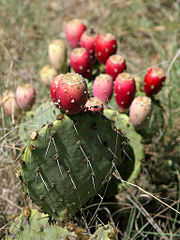
GUANAJUATO="0"The prickly pear cactus is the source of two staples in the Mexican diet: nopales, the cactus pads, and tuna, the fruit. The fruits vary in color from yellow-orange to red to nearly purple, but the red fruit is the best tasting and most popular. Harvest time is late summer into early fall. Once the fruit is plucked from the cactus, it needs to be used quickly as it will begin to ferment.

This cactus is found in the southwestern deserts of the United States through Mexico and Central America and into South America. It can also be found in southern Europe around the Mediterranean Sea.

Some people claim the pectin in the fruit lowers "bad" cholesterol levels and reduces the need for insulin in diabetics. Studies are being done to test these claims, but there are no definitive results at the present time.

Prickly pear fruit is a good source of fiber, magnesium, calcium, potassium, and Vitamin C. In addition, it is rich in the amino acid taurine (important for brain and heart health) as well as flavonoids, antioxidants that help keep the arteries healthy.

The fruit is eaten raw, dried, pureed to make salad dressings, candy and desserts or cooked to make juice, jelly and nectar. If you buy the fruit in the market, the spines should have already been removed, so the fruit is ready to be peeled and used. If you harvest the fruit yourself, you will need to wear heavy leather gloves to pick it, then scrub them well or use a knife to remove the thin spines.

Though we have seen this fruit in the market and at all fruit stands around town when it is season, we have yet to try it. When we used to keep parakeets and conures, we would buy the fruit for them but never tasted it ourselves because the fruit had a very strong and not entirely pleasant aroma. The birds evidently liked the smell because they would start chattering and screeching as soon as we started cutting it up. We could hardly get the dishes of fruit inside the cages because the birds were so eager to start eating. They ate every scrap.

This year, we are going to be brave and buy some as soon as it is in season. We'll let you know what we think.

By the way, if you want the sweet variety of prickly pear cactus fruit, choose the red fruit. There is a yellow-green fruit, called xoconostle, which looks similar to the red fruit but is acidic. The xoconostle is often used in savory sauces for meat and as a vegetable, but is also made into candy and jelly. Xoconostle is a Náhuatl word that means, "sour cactus fruit."

###

A Walk Through Mexico's Crown Jewel: A Guanajuato Travelogue

Thursday, May 14, 2009

Hotel Posada las Campanas: Pleasant hotel close to the center

My husband and I stayed at this clean, comfortable hotel conveniently located just two blocks from Dolores Hidalgo's main plaza. Our room had two double beds, a color televison with cable, telephone, good lights for reading, a small closet, and a small, but adequate bathroom. There was plenty of water pressure and plenty of hot water in the shower.

Only six of the hotel's 38 rooms and five suites are located on the first floor. There is no elevator, so you will have to climb stairs to get to your room if the six first-floor rooms are occupied.

There is a terrace on the third floor with a great view of the city and of the Templo de la Asunción (designed by Zeferino Gutiérrez, who also designed the parish church in San Miguel de Allende).

The six first-floor rooms face a sunny patio at the back of the hotel (very quiet).

The hotel has an intimate bar off the lobby as well as a restaurant where breakfast is served from 8 a.m. to 11 a.m. The restaurant offers a buffet of cereal, juice, milk, fruit, pastries, coffee, and your choice of two entrees for $49 pesos per person.

In addition, the hotel provides purified (bottled) drinking water and wireless internet. The web site indicates there is parking, though we didn't see a parking lot.

We would definitely recommend this hotel to others. It was a good value for the money.

Unique Qualities: The hotel staff was very friendly and helpful. The breakfast was more than adequate. Also, the hotel is close to the museums, churches, and market as well as to several artisan shops.

Phone: (718) 182-0427/182-1424

Address: Guerrero No. 15, Zona Centro, Dolores Hidalgo, Guanajuato CP 37800 Mexico

Directions: Just east of the corner of Guerrero and Distrito Federal...two blocks from the Jardin Principal

Website: www.hotelposadalascampanas.com

Other Contact: Fax (418) 182-2423

###

THE PLAIN TRUTH ABOUT LIVING IN MEXICO

ORDERING AND MORE INFO

Wednesday, May 13, 2009

Spanish Learning Chapter - 15

The Affective Factor

The chief problem for most Americans who want to learn Spanish but who don't succeed is the Affective Factor. Plainly put, this means the emotional issues; that is, adults become freaked out at the thought. The fear of getting put on the spot and embarrassed is just too much to bear.

I've talked to plenty monolingual American and Canadian expats in Mexico who do not learn Spanish. They are, therefore, forced to live in the various Gringolandias because they are too fearful of learning Spanish. They self-perceive the problem as their "advanced years" or, as one cantankerous old coot put it, "I have too lousy of a disposition to learn Spanish."

Really, the fear of making a mistake is the issue here. If you attend a class, you are put on the spot when your turn comes to produce something verbally in the language. You've got to perform in front of others who may be really, really good in the language. This is too much for some folks. Adults tend to come to the private schools in Mexico where students at all manner of levels are mixed into the same class. You might be performing in front of someone who is advanced. You think to yourself that you are going to die of humiliation because you will have to speak Spanish in front of them. You sense they are bored, and they are-you are freaked!

So, what is one to do?

Prepare before signing up for a class at home or abroad.

One of the biggest hoaxes in foreign language instruction is that you have to come to the country where the language you want to learn is spoken. That expensive and time-consuming act is erroneously called "Immersion." It is not going to be true Immersion as Immersion is defined along linguistic terms. If you go to the country where the language you desire to learn is spoken, classes will most likely be taught the same way classes are taught in the States, only all in the host language.

You will not have the skill to ask a question even if you understand what is being taught.

Do your own preparation in the privacy of your own home until you have built up a level of confidence to produce the language in front of a teacher and fellow classmates.

Use the commercially available products on the market to acquire some of the language before you launch into a performance situation in a class in front of others!

The Natural Order Hypothesis

In second language acquisition research conducted in 1974-75, 1980 and 1987, it was postulated that the acquisition of grammatical forms followed a natural and predictable order. How this happens is contingent upon multiple factors. The learner's age and the learner's circumstances seemed not to be a significant influence on this natural order. Dr. Krashen makes the point that this does not mean some sort of curriculum should be devised based on this order.

Krashen's entire point seems to be that there is a difference between the conscious learning of grammatical structures and the unconscious acquisition of speech, no matter the language. Acquisition of speech is far more important in the empowerment of someone who wants to speak the language-spoken fluency.

Critics would say Krashen has drawn too rigid a line between the learning and the acquiring of a second language. Some believe Krashen made these distinctions based on a specific or particular environment in which the learners were found and did not consider the classroom might be an environment that would have some importance in second language acquisition.

Krashen's critics do agree with him that the mass teaching of a linguist's approach to cold, grammatical principles does not facilitate second language acquisition. They go on to suggest that within a classroom, it would be best to help the student construct his own grammar so that he might reach full mastery of the language.

This seems to me to be a throwback to some earlier approaches in which the student, through some kind of touchy-feely existential probing, comes up with "his own grammar."

A natural order might, on the other hand, emerge in the process in which the child, or the second language learner, hears hundreds upon thousands of repetitions from those within the learner's environment who speak the language with correct form and structure. This situation is where the unconscious assimilation of correctness comes. Language is then acquired!


###


ROCKET SPANISH

FREE 6-Day Spanish Course!

Click On This Link Reach The ROCKET ROCKET SPANISH Website!

Tuesday, May 12, 2009

La Bohemia Restaurante-Bar: Good Food, Good Service, Good Location

La Bohemia is a small restaurant conveniently located in Guanajuato's main plaza (Jardín de la Unión) that opened for business on April 2, 2009. Don't let the recent opening dissuade you from eating there, though. The owner has more than 42 years of experience in the hotel and restaurant business. When this property became available a few months ago, the owner decided to combine his two existing restaurants and move to the new location.

The restaurant offers several breakfast choices including omelets, eggs, chilaquiles, French toast, pancakes, a fruit plate, and cereal. For lunch and dinner, it offers everything from quesadillas, hamburgers, and sandwiches to steak, fish fillets and stuffed chicken breasts. The menu also includes several soups, salads, appetizers and desserts.

For a filling meal that won't break your budget, try the meal of the day for $55 pesos. The menu rotates from day to day and includes your choice of two soups and two entrees, salad, rice, bolillos (French bread-type rolls), and a fruit drink. The owner says he has about 50 different meals that he plans to rotate for the meal of the day.

Vegetarians who eat eggs and cheese can have a good meal here as the menu offers a couple of meatless egg dishes, chilaquiles, cheese enchiladas, mixed vegetable salad, green salad, guacamole, beans, quesadillas, queso fundido, several soups, and spaghetti.

Besides coffee, tea, soft drinks, and fruit drinks, the restaurant offers a wide variety of alcoholic drinks.

The service is very good. The food is tasty, well-prepared, and attractively presented.

One thing that impressed me was that the silverware and napkin for each place setting were placed in plastic bags instead of sitting open on the tables.

There are four sets of French doors along two sides of the restaurant, which are kept open during business hours. It is pleasant to sit inside but still have a breeze and be able look out into the plaza. In the evenings, you can listen to the music of several mariachi bands that stroll around the Jardín.

The restaurant is open from 8:30 a.m. to 11 p.m. and also offers delivery.

Coming soon: New, more comfortable chairs and the menu in both English and Spanish


Favorite Dish: My favorite dish so far (though there are many other choices I can't wait to try!) is milanesa de pollo. This is a chicken cutlet (pounded very thin) that is lightly breaded and fried. It is served with a mound of rice and vegetables, and a small salad (more like a garnish) of shredded lettuce, a couple of slices of cucumber, a slice of tomato and a drizzle of salad dressing. The milanesa was cooked just right....not greasy or too crispy. The salad dressing tasted freshly-made.

The dish was attractively presented and the food was fresh and very tasty. The price ($55 pesos) is about average for downtown Guanajuato.

Theme: Mexican

Comparison: about average

Prices: less than US$10

Phone: (473) 731-9772

Address: Jardín de la Unión No. 4; Guanajuato

Directions: At the tip of the triangular plaza (Jardín de la Unión) across from Hotel Santa Fe. Close to La Michoacana ice cream shop and the Starbucks coffee shop.

###

ORDERING AND MORE INFO

Monday, May 11, 2009

Spanish Learning Chapter - 14

The Silent Method


A most bizarre philosophy of education called "Discovery Learning," based partly on the educational ideas of Rousseau, Pestalozzi and Dewey, led to The Silent Way Method of Second Language acquisition. It also enjoyed the support of psycho-babblists (psychologists) Piaget, Bruner, and Papert.

Seymour Papert said,

"You can't teach people everything they need to know. The best you can do is position them where they can find what they need to know when they need to know it."

Though it is a nice-sounding axiom, I am reminded of the countries of the world in which this philosophy of education does not reign supreme. The students in these countries overtake our kids in almost every academic subject. The word "they" in the above quote bothers me. Who does the "they" refer to? A bunch of kids who do not want to be in a classroom learning anything? Kids forced to be there because Mom and Dad say so? I know "Discovery Learning" all too well since I received my "secondary non-education" in one of these schools.

In response to what was considered as the "demonic" rote memory of anything having to do with education, The Silent Method of Second Language acquisition arose. In this "affective" approach, " The teacher tries to "facilitate" activities whereby the students discover for themselves the conceptual "rules" governing the language, rather than imitating or memorizing them - Brown (1994:63)." Also, the students had to somehow "develop their own inner criteria for correctness" (Larsen Freeman, 1986:62)."

This touchy-feely method of learning depends on the "good intentions" of learners. It also depends on the learners wanting to be in the educational situation in which they are, of course, forced by the law of the land and the law of home to participate. This approach to American education, in which I was a high school victim, resulted in woefully equipped and inadequately trained high school graduates (no one, of course, was ever failed) trying to get into college (one of our English classes was called, "Sports Illustrated").

Reasons for Failure:

Teacher is too passive. In favor of the student engaging in his own "Discovery Learning," the teacher would not step in to correct or guide the learner. Students would learn incorrect pronunciation in favor of the teacher remaining "silent."

Students miss out on cultural input that could be given within the language from the teacher's active participation.

Suggestopedia

Georgi Lozanov, a Bulgarian psychologist, introduced what he undoubtedly thought an original and brilliant premise: "... students naturally set up psychological barriers to learning - based on fears that they will be unable to perform and are limited in terms of their ability to learn." Anyone who has ever taught American Junior High school could have told him that.

Adults, particularly, have what I call, "the embarrassment factor" when it come to learning a new language. The thought of losing face is a hindrance to learning a language.

Lozanov held the idea that the human brain could retain and process much more if a more ideal learning environment (conditions) could be achieved. A kind of hypnosis-like hocus-pocus was thought to help the learner overcome self-perceived limitations. He set about creating a method in which an ultimate state of relaxation could be reached, thus increasing the amount of material one needed to learn.

Baroque music was used to facilitate this state of relaxation and ultimate concentration. Extremely comfortable chairs, soft lighting, and a general manipulation of the classroom environment (which was found to be highly impractical in a classroom-imagine adolescents with raging hormones in this scene!). Teachers were given the role of "suggestionists," thus creating this kind of hypnotic approach to learning a second language.

Though a strange approach, the language seemed to be taught by learning dialogues while sitting in overstuffed chairs, listening to relaxing music in the dark while listening to your teacher trying to put the whammy on you. I would have fallen asleep and never learned a word of any foreign language. The environmental factors would have been impossible to implement in a large classroom full of children or adolescents.

I do know of home-study courses that use this method and of those who have used it successfully outside of any classroom.

###


A Walk Through Mexico's Crown Jewel: A Guanajuato Travelogue

READ MORE "THE PLAIN TRUTH ABOUT LIVING IN MEXICO" BOOK REVIEWS

"THE PLAIN TRUTH" ORDERING AND MORE INFO

ROCKET SPANISH INFO AND ORDER PAGE

Sunday, May 10, 2009

Taco Pizza: Great food at a great price

Restaurant Name: Taco Pizza

The restaurant is small with about ten tables. The grill/prep area in the back is open to the restaurant. Besides sit-down dining, the restaurant offers to-go orders, pizza by the slice, and delivery.

It is clean and the staff is friendly. The service is fast even when the restaurant is crowded.

The restaurant is located just across the street from Dolores Hidalgo's main plaza on the corner of Guerrero and Jalisco.

Besides pizzas, the restaurant serves hamburgers, tacos, arrachera (strips of marinated flank steak) and tortas (sandwiches).

Favorite Dish: It's hard to choose a favorite dish at this restaurant because everything is good! Probably my favorite is the torta cubana. It consists of ham, chorizo (Mexican sausage), beefsteak...all finely minced and covered with melted cheese and served on a soft bun. It is served with sides of spicy red salsa, limon halves, and a wonderful guacamole sauce. The best thing is the price....$15 pesos....just a little more than a dollar.

Address: Corner of Guerrero and Jalisco

Directions: Just across the street from the southeast corner of the main plaza. Next door to the Pollo Feliz restaurant.

###


READ MORE "THE PLAIN TRUTH ABOUT LIVING IN MEXICO" BOOK REVIEWS

"THE PLAIN TRUTH" ORDERING AND MORE INFO

Saturday, May 9, 2009

Spanish Learning Chapter Thirteen

The Grammar Translation Method


The grammar translation method of second language acquisition is virtually the only method used in most language courses taught in classrooms all over the world. It is also known as The Classical Method. This method was developed over centuries to teach classical languages. Latin and Greek were seen as important "dead languages" to learn in order to read ancient texts, understand the origins and basics of the grammar and vocabulary of modern languages as well as the influences Latin and Greek had on them.

Literally, you learn through the memorization of grammar rules and lifeless vocabulary (not taught in the context of real life speech) how to translate and read a piece of written text. Latin and Greek are still taught this way today, the same way as they have been taught for centuries. So are most modern languages. You engage in an unimaginably boring process and somehow, though no one tells you how, you are supposed to arrive at the goal you are seeking in taking these courses: spoken fluency.

The reason The Grammar Translation by design does not work to give you any degree of spoken fluency is because it concentrates on short and long-term memory. You have to engage in intense memory work to try and recall the rules of translation. You also have to try and engage memory for the massive amount of vocabulary you must remember for the written tests within the course and to perform translation tricks.

This method is still taught today because "that's how we've done it all these years." More than 40 years of linguistic research in second language acquisition is totally ignored in favor of, "that is how we've always done it." Tradition and blind allegiance is a woeful combination.

If what you are seeking is real fluency in speech and listening comprehension, then this method doesn't work. There really is a natural progression to acquiring speech no matter if it's your first or second language. It involves developing a "speech center" in your brain that is not connected to memory. When you are shown a picture of a cat, immediately in your brain you can utter the word "c-a-t" in your native language. You did not engage in short or long-term memory work in order to do this. It comes automatically without translation or even thinking. You "just know" the word for cat in your native tongue when you are shown the picture.

That's what you are shooting for in true second language acquisition. Not memory recall as is involved in The Grammar Translation Method. What you want is thinking in the language. The Grammar Translation Method is not going to give you that.

The Direct Method


Realizing that The Grammar Translation Method of second language instruction did not work to impart spoken proficiency in the target language, in the late 1800's, The Direct Method surfaced in language instruction. The need for a system that worked to teach spoken competence is what drove those to create The Direct Method. What it entailed was methods of language acquisition that were more closely related to how first (native) languages were acquired. The main goal was to teach how to think in the second language and move as far away as possible from the harmful grammar-first approach. It did not seek to make constant references to one's first or native language, as does The Grammar Translation Method.

The Direct Method brought a new wave of thought into this type of teaching. The shift in philosophy of second language education led its proponents to believe that all instruction should be taught in the target language with no translation into the learner's native tongue. The emphasis was in forming connections between meaning and the one being learned. One of the major and famous advocates of The Direct Method was Charles Berlitz. His schools still employ this method and are famous worldwide.

The basic idea was to learn to think in the language one wanted to learn. This was to be done without relating the learner's first language to the second language at all. Through the use of picture and pantomime, meaning was to be conveyed. The objective was to make links between meaning and the target language. If you were shown a picture of a cat, the word c-a-t in English would not be used to help you learn that in Spanish, the word is gato. The picture would convey the meaning of the word spoken by the teacher.

A problem with The Direct Method is that it met with opposition in public schools that are governed by strong political forces. Second language learning, for communicative purposes, was never popular in education and especially in mainstream America. Budgets, time, classroom size, and teacher incompetence were all cited reasons for sending The Direct Method into decline in the public eye. It is still employed in private schools.

It is the basis for The Audiolingual Method of Second Language Instruction.

The Audiolingual Method

This method of second language instruction was a further development or evolution of The Direct Method. World War II rose up and slapped the U.S. government in its linguistically challenged face, waking it to the need and definite lack of language competency to deal with the other nations of the world. Apparently, the U.S. continues to find itself in this position with International conflicts. The lesson has to be relearned over and over again that bilingual fluency is crucial for Americans. Without it, other nations, some of which are our enemies, have the distinct advantage.

The Audiolingual Method incorporated much from The Direct Method. To that method, it added the concept of recognizing patterns within languages to try and teach communication ability within the target language. Drills and extensive repetition exercises were used to impart an "over learning" of the material that could impart the patterns of the language and, hopefully, make automatic responses within the minds of the student when hearing and speaking the language.

To facilitate this, one engages in a lot of memorization of dialogues in the target language, complex but useful drills, and grammar games. One technique used in this method, one that the Pimsleur Language products use, is the expansion or "backward build-up" drill.

This is where a sentence or new vocabulary word is broken down in parts or syllables. The student either starts from the end of the final word in a sentence and repeats each word within the sentence working backward or begins with the final syllable of the word and repeats each syllable, again working backward until the entire word is pronounced. This is highly effective when done correctly. You will see this used extensively in the Pimsleur and Learning Spanish Like Crazy courses.

The Audiolingual Method works and brings rapid success but is not without its critics. It was argued that this method was just rote memory work and did not take into consideration the emotional factors in second-language acquisition. This paved the way for newer methods.


###


ROCKET SPANISH

FREE 6-Day Spanish Course!

Click On This Link Reach The ROCKET ROCKET SPANISH Website!

Friday, May 8, 2009

Hotel Posada Hidalgo: Conveniently-located hotel

My husband and I have stayed at this hotel twice. It is our favorite hotel in Dolores Hidalgo. The hotel is located just a block from the bus station and less than two blocks from the town's main plaza.

The hotel is very clean and the staff is very friendly and helpful.

There are six rooms with one double bed, sixteen rooms with two double beds, and two suites that feature a king-sized bed and a sofa bed. At the present time, the hotel is in the process of adding more rooms.

Each room has a telephone, color television with cable and remote, a safe, and a ceiling fan. Bottled water is also provided as the tap water is not drinkable in most parts of Mexico. The hotel also provides complimentary bars of soap, shampoo and lotion.

The hotel also has wireless internet throughout, a work-out room with various pieces of exercise equipment, a steam room, a laundry room for guest use, and an indoor, covered patio area on the second floor. There is also parking for the hotel less than a block away.

If you find you have forgotten some toiletries or want a soft drink, there are some items for sale at the front desk. However, there is a small grocery store about three doors away from the hotel where you can buy whatever you need.

I would recommend this hotel because it is clean, comfortable, quiet, and conveniently located.

The hotel does not have a restaurant and does not provide room service. However, the hotel is located less than two blocks from the main plaza, where you can find a number of good restaurants.

There are rooms on both the first and second floors. There is no elevator, so if steps are a problem, ask for a room on the first floor. The second-floor rooms, at least the one we stayed in on our first visit, are larger than the rooms on the first floor.

Unique Qualities: This hotel is very close to the bus station and also has its own parking lot if you drive your car. It is very close to most of Dolores Hidalgo's attractions and to the market. It is also very reasonably priced ($348 pesos for one person; $398 for two; $448 for three: $498 for four; $548 for five).

Phone/Fax: 01 (418) 182-0477

Address: Hidalgo No. 15; Dolores Hidalgo, Guanajuato, Mexico C.P. 37800

Directions: On Hidalgo Street between Morelos Street and Chiapas Street. Just one block north of the bus station and one and one-half blocks south of the main plaza. --Cindi Bower

###

Highly Recommend "The Plain Truth about Living in Mexico" September 8, 2006

Reviewer: Bruce Drake Former Editor with National Public Radio (NPR NEWS Washington, DC) - As someone who has visited Mexico several times as I struggle with my study of Spanish, and who is thinking of moving there, I found this book to be far superior to the general run of guides on the expatriate life or retiring in Mexico. Some of the others of this genre just lack the ring of authenticity, or seemed to be aimed at people with a lot of bucks who are headed for a gated community or an expensive house in Cabo San Lucas. But the Bowers' book has that ring of authenticity and is squarely aimed at the (for lack of a better cliche) "average Joe" who is looking for a life that is different and/or better and needs down-to-earth practical advice on how an American can make this transition.

READ MORE REVIEWS

ORDERING AND MORE INFO

Thursday, May 7, 2009

Spanish Learning Chapter Twelve

Memory in Spanish Learning

learn to speak spanishThe truth is that as we age, some memory "deficits" begin to occur. The good news is these deficits are not necessarily set in stone nor are they irreversible. Though we cannot escape the often-inevitable loss of some cognitive functioning, like aging issues with memory, new research is showing that some age-related memory problems can be reversed with proper memory training.

This issue of memory is so important when it comes to learning a new language. We often feel completely overwhelmed at the amount of new vocabulary we need to master in order to develop a high degree of spoken fluency in the target language. But what the research shows, and what you can do about memory problems, may just surprise you.

Newer studies show some very promising hope for what used to be thought of as a hopeless situation with age-related memory problems. Older adults, it turns out, have unused resources in the left frontal cortex of the brain that can be used to compensate for normal memory loss.

There is now substantial evidence that growing old does not destroy the cognitive functioning required for memory in the frontal lobes of the brain. These new studies show older adults, as they age normally, find it more difficult to access the frontal lobes for memory functioning, something that younger people seem to utilize easily.

Younger people, when utilizing memory, seem to use the frontal left cortex almost exclusively for memory function. Older adults seem to gradually decline in spontaneous memory response in this area of the brain. Older adults struggle along processing memory using the parts of their brains that younger people use routinely and rapidly.

These studies provide strong support for the for the fact that though an individual may be suffering from some normal aging, no -related memory losses, if they are provided with specialized training, they can recover memory abilities once thought long lost to the aging process. The operative concept here is memory loss that is related to normal aging issues and not to an organic disease process.

What exactly is happening when we grow old and begin to suffer those "Senior Moments" seems to be a deficit in two issues of memory functioning: 1) a slowing of the ability to use that area of the brain best suited for memory processing, and 2) what seems a refusal to use memory techniques and training appropriate for reversing memory losses in those areas of the brain we used to use when we were younger.

When we were younger and had a memory task to accomplish, our brains would select almost instantly the preferred region of the brain for memory processing. As we grow older and begin to suffer memory deficits, our brains are NOT using the preferred regions for memory processing but other regions not as effective for memory processing.

However, it is now possible, using proper memory training technique, to more fully access the preferred region of the brain for effective memory tasks at levels closely approximating that of young adults.

The specific memory issue with aging adults seems to be with the short-term memory. An older adult, for example, can recount a story that happened twenty years previously but cannot recall to whom he's already told the story. However, this does not appear to be an issue of concentration or attention but, rather, an issue of distracting influences.

Studies from The University of California at Berkley, using Functional Magnetic Resonance Imaging, show for the first time that memory problems are due more to trying to filter though irrelevant information than a problem of focusing on the information that is relevant.

In other words, just focusing on the information the older adult is trying to recall isn't enough. He also has to filter out the irrelevant information that is distracting. The problems with filtering through the distracting information may be what is the root cause of memory problems that too often accompany aging.

Think about this for a moment. If you cannot successfully filter out the distracting information, you cannot get at the information that you are trying to bring up from your memory-the information you do want to recall. It is not that you cannot remember something; it is, rather, that you cannot block or filter the extraneous information that is preventing you from remembering what you want to remember.

In the Berkley studies, the younger test subjects were able to more easily filter out distracting information that was not pertinent to the memory task than were the older adults. An interesting sideline to the Berkley tests was that not all of the older adults suffered aging-related memory losses.

The overall conclusion from the studies shows that older adults are able to focus on relevant information but are troubled with the diminishing ability to ignore distracting information, thus resulting in memory problems. They cannot recall the desired information because they cannot block extraneous information.

Memory Training with patients who do suffer some sort of organic brain disease shows promise for those with simple age-related memory issues. Memory training is shown to help some patients suffering from the early stages Alzheimer's disease improve their memories. This astounding finding points to the possibility of some sort of intervention for sufferers of this disabling disease as well as to the urgency for the earliest possible diagnosis.

Through the use of memory mnemonics, which uses images from pictures as well as visualizations to prompt the memory via a meaningful association, there was a significant improvement in memory in Alzheimer's patients on items that were included in the training program.


The most amazing finding was, through the mnemonic memory training, the patients were able to retain their memory improvements for up to six months after the training. These promising results apply not only to those who suffer from an actual organic brain disease such as Alzheimer's but also for those who suffer normal age-related memory problems. It also suggests that certain areas of our brain may be able to take over the functions of those area that are damaged through disease, injury, or simple, age-related memory losses.

###

learn to speak spanish"Give Me 2 Minutes And I'll Show You How To Learn Real Latin American Spanish With A Learning Method That's Fast, Fun, Easy, and Guaranteed..." CLICK HERE

Wednesday, May 6, 2009

Spanish Learning Chapter Eleven

If you have successfully completed at least The Learnables and The Pimsleur Spanish, Learning Spanish Like Crazy courses, you are ready for the formal study of Spanish (i.e., grammar).

I know this is very costly. I know because I've paid the price myself for these courses. But what do you want? Do you want to become proficient in the language or do you want to start with formal courses that do not teach you spoken fluency? With the former, your investment pays off. With the latter, you are pouring money down the drain.

At this point, a very logical question may come to mind. After paying all that money for The Learnables and The Pimsleur Spanish, Learning Spanish Like Crazy courses, why should you take on more course work, for more money, at the college level? You may be right in asking this question.

If what you want is spoken fluency and you do not care if you learn to read and write in Spanish, then formal grammar courses may not be for you. I get that. It makes sense. But if you want to go after the ability to read and write in the target language, NOW is the time for formal study in the classroom.

After completing The Learnables and Pimsleur Spanish, I attended four months of Total Immersion course work in Guanajuato, Mexico. This was nothing more than the identical course work available at any U.S. college or university, only it was taught completely in Spanish. The classes used the same method, the same grammar, the same everything--only everything was taught in Spanish.

I am convinced that had I NOT had the preparation of at least The Learnables and Pimsleur Spanish, Learning Spanish Like Crazy I would not have made it in the formal coursework. What I learned in the formal classes-the grammatical structures-made sense to me instantly because I had developed a high degree of spoken fluency BEFORE I entered the formal grammar sequence of study.

Now that you have some fluency in spoken Spanish, you are ready to simply enroll in Spanish I at your local college or university. You will, as I wrote earlier, receive a textbook, workbook, CD or cassettes, and a class syllabus. It will seem painfully simple because of your previous preparation but will be an easy "A." In fact, I believe you will be able to "cruise" through the Spanish courses with ease, or at least with greater ease, because of your study with the methods I outlined in the previous chapters.

This formal coursework will prepare you for the study of Spanish literature if you so desire. It will also enable you to read other works in Spanish from the newspaper to novels-if that is what you so desire.


Going to the host country of the target language has always taken on a sort of mythical quality. It has been believed that you could not learn a foreign language unless you went to the country associated with the target language and engaged in something called Total Immersion.

Total Immersion is NOT a protracted amount of time of traditional language learning instruction in the target language's country. Coming to Mexico and studying Spanish using traditional language learning methods is NOT a Total Immersion program. It bears repeating once again:

What is not commonly known is most of these university-level programs require that you have at least 4 semesters of the target language before going abroad. This was true more than 30 years ago.

Here is the myth. It is believed that if you come to the country of the language of your choice, some sort of linguistic hocus-pocus will one day swoop down on you, possess you, and you will mystically know the language. I mean, really, come on. Let me set you straight right now. There is NO magic in spending a small fortune in coming to live and study a foreign language in a foreign country. The Spanish fairy is not going to show up some night while you sleep and do the "now-you-know-Spanish" spell over you. It is NOT going to happen.

The only difference in your coming to Mexico to study Spanish is that all the classes are going to be taught in Spanish. They will use the same method used in the United States. You will get a textbook-sometimes-and attend a conversation class. You will still have to study your buttocks off. The only difference is there are more opportunities for practice in the foreign country than you had at home.

But here is what we see all too frequently. These American college students come here and hang out with other American students. They spend what precious time they have in Mexico speaking English with their companions instead of hanging out with the locals and speaking Spanish.

This is one reason why the so-called Total Immersion experience is a waste of time and money. If what you are going to do is spend all your out-of-class time hanging out and speaking English with your fellow Americans, then what is the point? We see this too in adult students who come to the private language schools.

Are we still wondering why America is only 9% bilingual?

Here is another problem with the so-called Total Immersion experience. There is the false expectation that if you haven't one word of Spanish under your belt, you can come and enroll in a beginner's class and start learning. Nothing can be further from the truth. First, there is the myth that says there is some sort of magic in coming to the foreign country to learn the target language. The second myth is these schools will take you at the absolute beginning level-WRONG.

All the schools in Guanajuato, as well as most of the others I have contacted in my research for this book, confirms what my experience already taught me. When you come to the country of the language you are trying to learn and enroll in one of the private schools, you will be coming into the beginning, or the middle, or at the end of a sequence. What I mean is this.

When I first came to language school in Guanajuato, I came into an intermediate class that was already into the 4th week of the sequence. They did not start a new intermediate class just for me. I was stuck in a class where 4 students had already been going through intermediate instruction for 3 weeks before I got there. I came into the 4th week of instruction.

If you are a rank beginner and do not even know the Spanish alphabet much less the difference between the verbs ESTAR and SER, you will not necessarily come into the beginning session of a beginner's class. Do you get what I mean here? You will be sandwiched into the level at which you test but you will be put into the instruction where everyone else is presently at.

We heard of a lady from America who had absolutely no Spanish-none. She paid for three months at a very expensive private language school. She expected to be placed in a class for absolute beginners. To her shock and surprise, she was put into a class of beginners who had been there for several weeks and had completed most of the beginning class's cycle. Even though they were beginners, they were much too advanced for her. She was lost.

You have to see the school's logistics in all of this. The school could not start a class for all the different levels at which all the different enrolled students tested. Just think of it. You could have 100 students all at different levels. The school would have to offer 100 different classes with 100 teachers to accommodate the needs of all 100 students. Schools have to have "cycles" in each level of instruction in which to insert the students.

Most Americans do not know this when they enroll in what are touted as Total Immersion classes in foreign countries.


At the University of Guanajuato, there are classes that start at the beginning of each semester. So, you could be a rank beginner and begin in a rank beginner's class with the rest of the rank beginners at the start of the rank beginner's cycle. This operates just like classes in the United States. The private schools, however, cannot do this. You might "luck out" in one of the private schools and happen to time your study vacation when the beginning of a beginning, intermediate, or advanced level cycle is starting but don't bet the farm on it.

###


ROCKET SPANISH

FREE 6-Day Spanish Course!

Click On This Link Reach The ROCKET ROCKET SPANISH Website!

Learn Spanish Like A ROCKET With Rocket Spanish!...Who Else Wants to Learn to Speak Spanish Confidently and Naturally In Less Than 8 Weeks??... AND take all the frustration, difficulty and headache out of YOUR practice time with this EXPLOSIVE interactive 'learn Spanish' package!